
Sodium-ion Battery Commercialization Takes a Giant Leap: Hard Carbon Cost Breakthrough Paves the Way for Mass Adoption
Hard Carbon Price Halved Within Two Years
Back in 2024, hard carbon was priced at 60,000–70,000 CNY per ton. The anode material alone accounted for more than one-third of the total LFP cell cost. Even with cost savings on current collectors and cathode materials for Sodium-Ion Batteries, the overall cell price remained higher than LFP counterparts.
This landscape is now shifting.
Expanding production capacity acts as the primary driver. Over the past two years, leading hard carbon manufacturers have launched multi-ten-thousand-ton production lines. The global industry capacity has risen from less than 100,000 tons in 2024 to 350,000 tons in 2026. Small-batch manufacturing has been replaced by automated continuous production, removing supply bottlenecks.
Precursor routes keep evolving rapidly. Major manufacturers are reducing reliance on expensive biomass feedstock, while petrochemical-based and coal-based precursors are widely adopted, cutting raw material costs by nearly 40%.
Production yield has also improved steadily. The industry average yield has climbed from below 80% to over 95%, significantly lowering energy consumption and scrap losses per unit product.
Combined effects of capacity expansion, precursor material substitution and yield improvement have pushed hard carbon prices down to the range of 20,000–40,000 CNY per ton.
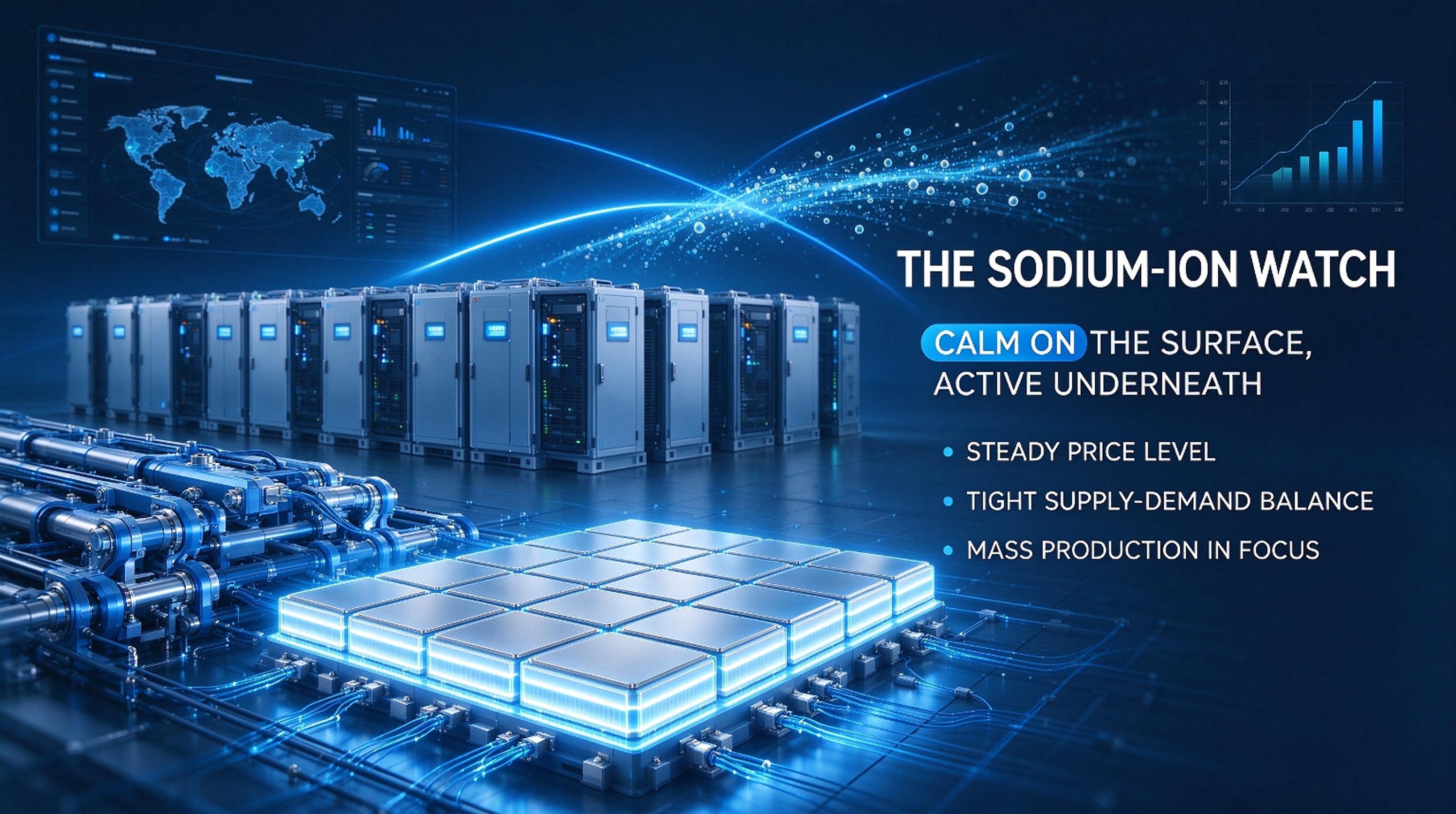
Cost Parity Achieved: Sodium-ion Batteries Gain Strong Market Competitiveness
Calculated based on current material pricing, the material cost of sodium-ion Battery Cells can fall below 0.28 CNY/Wh. Leading players have achieved scaled production costs under 0.3 CNY/Wh, reaching cost parity with mainstream LFP batteries. Industry forecasts project sodium-ion cell costs to drop to 0.22–0.25 CNY/Wh in 2027 and 0.18–0.2 CNY/Wh in 2028.
Sodium-ion batteries are no longer “theoretically cheaper” — they have become economically competitive in real applications.
Engineering Challenges Remain Despite Cost Progress
Falling hard carbon prices inject strong momentum into sodium-ion battery industrialization and push sodium-ion technology from technical validation toward commercial competition. However, cost reduction is only the starting point. Mass-scale deployment still depends on solving a series of engineering challenges when translating lab materials into mass production.
Hard carbon still has room for optimization in initial Coulombic efficiency, low-voltage plateau capacity, precise pore structure tuning, fast charging performance, long cycle life, compaction density, batch consistency, raw material & process cost and full-cell matching. For energy material enterprises, replicating excellent lab performance stably at ton and multi-ten-thousand-ton production scale is critical to turn technical feasibility into reliable, cost-effective products.
Future competition in the sodium-ion battery industry will go beyond single material performance. It will cover the full spectrum of material design, process development, pilot scale-up, quality control and mass production validation.
As a technical service provider bridging R&D innovation and industrial manufacturing, JAFORD supports energy material firms to tackle technical and engineering bottlenecks from lab research to industrialization. We streamline the full path of research – validation – scale-up – mass production, enabling advanced sodium-ion battery materials to move out of laboratories, onto production lines and deliver stable product value and market competitiveness.